Cupping Guide
A tight back asks for pressure; a cup offers the opposite. Out here in the fog belt, where shoulders and lower backs spend half the year clenched, that reversal has a devoted following.
Why People Try Cupping When Their Back Is Tight
Cupping for back pain occupies an odd spot: the research behind it is thin, yet it's among the most requested services at our Outer Richmond studio, and many guests say their back feels looser afterward than pressing alone has managed. NCCIH, the federal center that studies practices like this one, has reviewed the trials and found them too small and mixed to support firm conclusions. We offer it anyway — as a comfort practice with a long history, and for how it feels on a back that has stopped responding to thumbs.
Some of you found this page by typing cupping therapy for back pain San Francisco into your phone at some late, sore hour. The question underneath is the same one we hear at the front desk: my back is tight, pressing on it hasn't been enough, is this worth trying? In the Outer Richmond the pattern repeats weekly — desk workers whose lower backs have stiffened after months in a home-office chair, runners sore across the mid-back after Ocean Beach miles, gardeners and contractors who finish the week with shoulders set like poured concrete. Cupping for back pain is what they reach for when they want to come at the tightness from a different direction.
Press, then pull — the two directions reach more of the back than either does alone.
What Cupping Actually Does on a Back
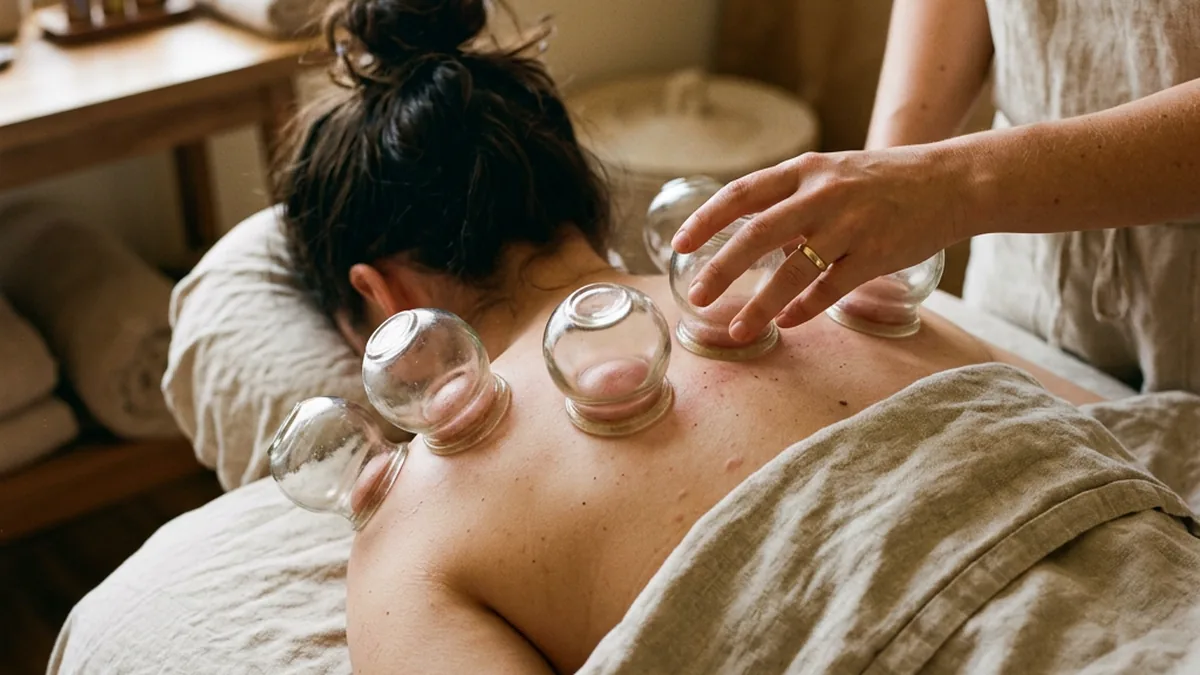
Cupping looks stranger than it is. In the Chinese glass fire cupping we practice, your therapist holds a small flame inside a glass cup for a moment, sets it mouth-down on the muscle beside your spine, and lets physics do the rest: the warmed air shrinks as it cools, sealing the rim and drawing the muscle surface gently upward into the glass. The flame warms the cup, never you, and the skin is never pierced; we don't do wet cupping at all.
Lift Instead of Press
Nearly everything else we do to a tight back presses down into it — thumbs, palms, elbows, hot stones. A cup is the one tool on our table that pulls. Instead of compressing muscle, suction creates a kind of opening, and guests often describe it as a firm, oddly satisfying stretch arriving from underneath. We keep the claims modest: cupping may help ease muscular tension, and it supports the sort of deep relaxation that lets a guarded back stop guarding. For a back that has spent weeks hunched over a laptop or braced through a long 38R ride, being lifted instead of pressed is new information — many people visibly let go on the table.
Where the Cups Go
For back-focused sessions we place cups on the broad muscle groups on either side of the spine — never on the spine itself — from the tops of the shoulders down through the low back. If you're coming in for cupping for lower back tension specifically, placements sit across the lumbar muscles, where a lot of backs quietly store their worst tightness. Your therapist adjusts the suction to your comfort, starts first-timers with a lighter draw, and will ease off or remove a cup the moment you ask. And since visits here don't rotate between staff, your second session picks up exactly where the first left off.
Reading the Marks
The round circles are the reason half the internet hesitates over cupping. Suction draws blood toward the surface and can break tiny capillaries, leaving circles that range from faint pink to deep plum; they rarely feel like anything at all. Guests sometimes ask us to read the colors like a diagnosis, and the honest answer is we can't — the shade says more about your skin and how long each cup sat than about the state of the muscles underneath, and it is not evidence of anything being drawn out of you. The circles clear on their own in three to seven days, and our cupping marks explained guide covers the rest, color by color.
Cupping Alone or Shiatsu + Cupping Combo?
Standalone cupping is $45 and is the shortest visit on our menu — you're on the table, cups on your back, and out the door without the time commitment of a full massage. It's the right call if you already know you like cupping, you're between regular massages, or you're watching the budget; our affordable massage page exists for the same reason. Adding cupping to any massage is $30, and the massage + cupping combo runs $115 for 60 minutes or $150 for 90.
For a chronically tight back, though, we usually recommend shiatsu and cupping for back pain in a single session — one appointment where both directions get their turn, and roughly what people typing cupping massage back San Francisco are looking for. Shiatsu is traditional Japanese finger and palm pressure along the body's meridians, done fully clothed under a blanket with no oil, and it warms and loosens the surface layers first. Then the cups take over and lift where the hands were just pressing. Press, then pull — the two directions reach more of the back than either does alone, and it's the pairing our regulars settle into most. The shiatsu + cupping combo page breaks down every session length.
One boundary we hold: if your back pain shoots down a leg, comes with numbness or tingling, follows a fall or accident, or wakes you at night, see a doctor before you see us. Cupping and massage are not a substitute for medical diagnosis or treatment. Once a clinician has cleared you, the table is here seven days a week.
What the Evidence Does and Does Not Say
The National Center for Complementary and Integrative Health is blunt about cupping: studies are mostly small and of mixed quality, and there is not enough good evidence to say it reliably works for any condition. Reviews looking specifically at cupping for back pain hint at possible short-term easing, but the trials are hard to blind — you know whether there is a cup on your back — so every result arrives with an asterisk.
What holds up without the asterisk is narrower but real. Cupping has a long history in Chinese medicine as a comfort practice rather than a treatment, many guests find it deeply relaxing, and plenty tell us their backs feel looser afterward, especially when the cups follow Shiatsu. Side effects at a careful studio are mostly the temporary circles and occasional mild skin irritation, and a short list of people should skip cupping entirely — that list is in the FAQ below.
Booking a Back-Focused Cupping Session
Booking cupping for back pain at Healing Shiatsu is uncomplicated: reserve through our online booking site, or call or text (415) 379-9739 and mention it's for your back so we can plan placements and timing. We're at 3735 Balboa St, between 38th and 39th Avenues in San Francisco's Outer Richmond, open seven days from 9:30 AM to 7:30 PM. Walk-ins are welcome whenever a therapist is free, but calling ahead is strongly recommended, especially on weekend afternoons. If you've been comparing back cupping SF options, ours has one quiet advantage: the same therapist every visit, so nobody relearns your back from scratch. Street parking on Balboa and the side streets is usually findable, and the 38 or 38R Geary bus from downtown drops you a short walk away.
A few practical notes for the day of. Wear a top that's easy to slip off, since your back needs to be bare for the cups — the Shiatsu portion stays fully clothed, so a combo just means the shirt comes off partway through. If you can come before 11:30 AM, the Morning Special prices a 60-minute body massage at $80 instead of $85; add the $30 cupping and the arithmetic lands at $110. And if this would be your first time under the cups, say so when you book. We'll start light, check in often, and let your back — not a sales script — decide whether you return.