Cupping Guide
The fog clears off Ocean Beach, you finish the long loop through Golden Gate Park, and your calves feel like guitar strings. Cupping won't make them heal faster — but on a rest day, the deep pull can help them let go.
Cupping for Sore Muscles: What It Is and What It Isn't
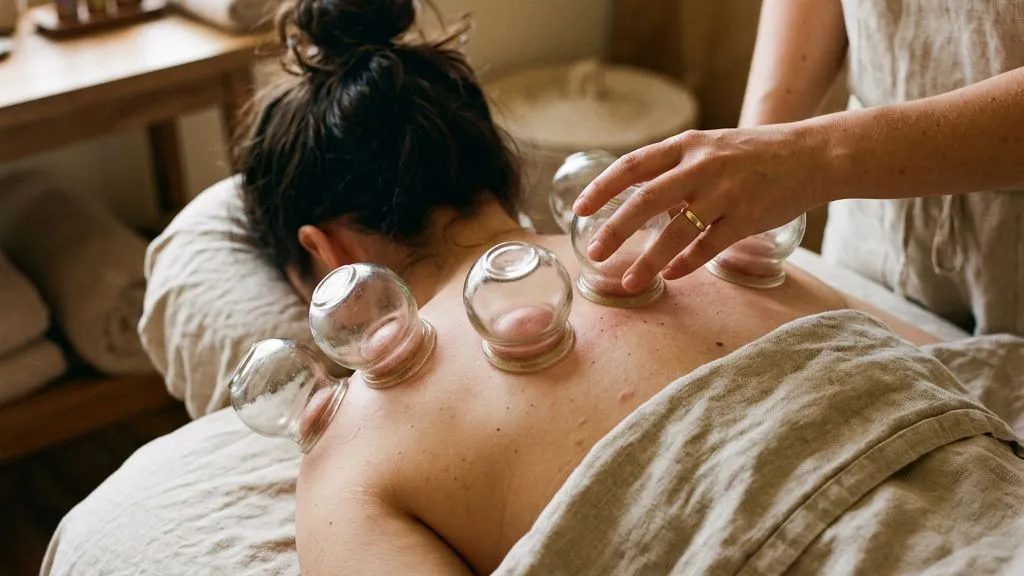
Recovery cupping is a traditional, dry glass-cup technique used after hard training. Your therapist warms the air inside a glass cup with a brief pass of flame, sets it on the skin, and as the air cools the gentle vacuum lifts the skin and surface muscle upward. That upward pull — the opposite of a thumb pressing down — is what runners, cyclists, and climbers tend to describe as a deep, releasing stretch across a tight muscle group. We use dry cupping only; the cup never breaks the skin, and we don't do wet cupping or bloodletting.
Here's the honest line we hold to: cupping does not flush lactic acid, it doesn't pull toxins out of your legs, and there's no solid evidence it repairs muscle or speeds recovery. The federal research agency that studies these practices, NCCIH, lists no condition cupping treats and cites no trial showing it works. So we treat it as a low-evidence comfort practice — a traditional way many athletes find helps them feel looser, used alongside the things that actually drive recovery, not in place of them.
Cupping won't make your legs heal faster — but on a rest day, many runners find the deep pull helps them finally let go.
Cupping for Runners, Cyclists, and Climbers Across SF
The west side of the city is built for endurance sport, and the bodies that come through our door show it. Road and trail runners arrive with tight calves and a locked-up IT band after Ocean Beach, the Golden Gate Park loops, or Lands End trail running and the Coastal Trail miles. Cyclists come back from the Marin headlands with sore quads, hip flexors, and a low back that's been hunched over the bars for hours. Climbers and boulderers turn up with cooked forearms and lats. Gym-goers come in after a heavy leg or back day.
For all of them, the use case is the same: sore, not injured. Cupping for cyclists tends to focus on the quads and low back; for runners, the calves and IT band; for climbers, the forearms and lats — and we often pair the work with shiatsu on the surrounding muscle. None of this is a treatment for a strain, a tendon problem, or a joint that hurts — if that's what's going on, we'll stop and tell you to see a provider. Cupping is for the ordinary training ache, the kind that just needs to loosen before the next hard day.
The Marks, and Why You Should Plan Around Them
The circular marks are the part people notice. They're pooled blood from tiny capillaries the suction ruptures just under the skin — the same biology as a bruise, made by a pull instead of an impact. They are not toxins coming to the surface, and the old idea that a darker mark means more 'buildup' or 'stagnation' is a myth, not a reading of your body. The marks usually fade in three to seven days.
That fade window is worth planning around. If you've got a race with finish-line photos, a wedding, a photoshoot, or a beach weekend, book your session about seven to ten days ahead so the marks have cleared. And it shouldn't hurt: a firm pull or a deep-stretch feeling is normal, but real pain is your cue to speak up — your therapist eases the suction or lifts the cup off right away.
A Sensible Recovery Routine on Balboa St
The rhythm we suggest is simple. Cup on a rest or easy day, not right before a race or a hard session, and never on a fresh injury. Afterward, keep the worked area warm, hydrate the way you normally would, and skip the hard workout and the alcohol for about a day so the easy movement can do its job. Mention blood thinners, a bleeding disorder, broken or infected skin, an eczema or psoriasis flare, or a pregnancy before we start — some of those mean cupping isn't a fit, and we'd rather know up front.
We're a small practice at 3735 Balboa St, between 38th and 39th in the Outer Richmond, open every day from 9:30 AM to 7:30 PM and rated 4.9 across 238 reviews. We're a short hop from Ocean Beach and the west end of Golden Gate Park, easy to reach on the 38 Geary, and same-day recovery slots are usually open on weekday mornings. Stop in after the long run or the long ride, tell us where you're tight, and we'll work it honestly — no toxin talk, no miracle claims, just careful hands and a clear sense of what cupping can and can't do.