Cupping Guide
The marks are the whole story. A swimmer climbs out of a pool with purple circles down his shoulders, the photo travels, and cupping gets described as ancient, powerful, and proven. Then you read what the federal research body actually publishes about it — and it's almost entirely about safety. That gap is worth sitting with before you book.
What Is Cupping Therapy and How Does the Suction Work
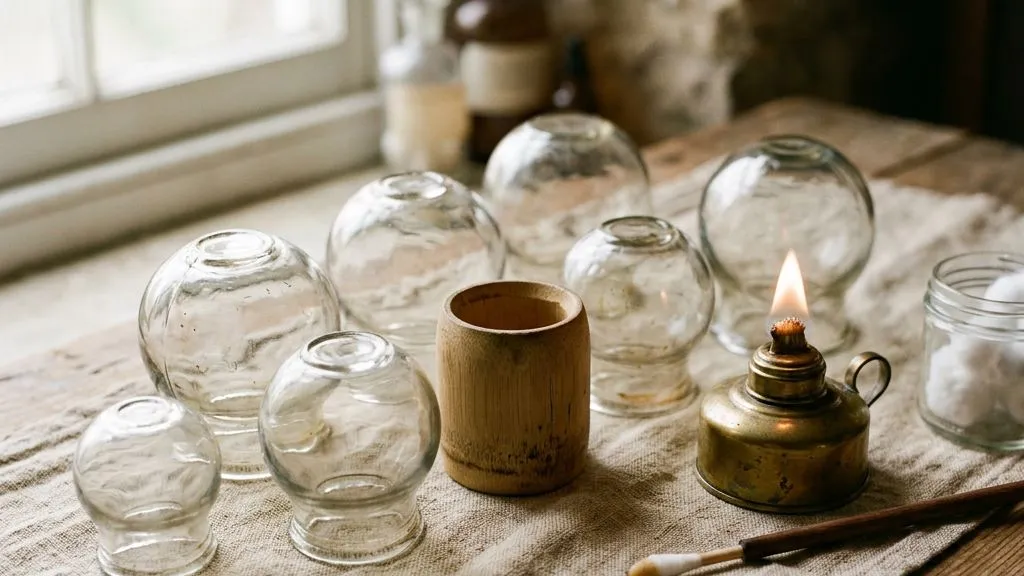
Cupping is a practice used in traditional medicine in several parts of the world, including China and the Middle East. The mechanics are simple. A practitioner places a cup — glass, ceramic, bamboo, or plastic — on your skin and creates suction inside it. There are two ways to do that. The older method, and the one we use, briefly applies a flame to warm the air in a glass cup, then presses the cup to the skin; as the trapped air cools and contracts, the negative pressure pulls skin and surface tissue up into the cup. The newer method skips the fire and attaches a suction device after the cup is in place.
The suction is the point. A massage therapist pushes down into tissue. Cupping pulls it up, and that pull is what draws a little blood toward the surface. The pooled blood under your skin is what you're looking at when you see the marks. It's a different sensation from thumbs or elbows — many guests describe it as a deep, satisfying stretch — and that's a fair reason to try it. It just isn't evidence of anything more than what it is.
The marks are pooled blood from tiny ruptured capillaries — the same biology as a bruise. A darker circle is not more toxins. It's just a bruise that suction made round.
Dry Versus Wet, and Why Glass Fire Cupping Stays on the Surface
The single most important distinction in cupping is whether the skin stays intact. The line is one sentence: in wet cupping, the skin is pierced and blood flows into the cup; dry cupping does not involve piercing the skin. That's a bigger gap than it sounds. Dry cupping leaves a bruise-like mark. Wet cupping is, by design, a procedure that opens the skin and deliberately draws blood, which moves the conversation from 'discoloration' to 'open wound,' with the heavier risks that come with it.
We do glass fire cupping, dry only. No incisions, no bloodletting. If a studio can't tell you plainly which one they do, settle that first — and either way, ask whether the equipment is single-use or sterilized between people. Because suction alone can break enough surface vessels to leave blood on the gear, that sterilization question matters for dry cupping too, not just wet. It's not an upsell. It's the line between a treatment and a way to pass something between clients.
Why You Get the Circles — and Why the Color Is Not a Diagnosis
The marks are not impact bruises, and they are not toxins being pulled to the surface, whatever the marketing says. Suction inside the cup ruptures tiny blood vessels just under the skin, and a little blood leaks into the surrounding tissue. The result is a flat, round patch — pink, red, sometimes nearly purple-black — tracing the rim of the cup. Same biology as a bruise, produced by negative pressure instead of a blow. They typically fade in three to seven days.
You'll often hear that a darker mark means more 'stagnation' or more toxins. It doesn't. How dark a mark gets depends mostly on how easily you bruise, how thin the skin is there, and how long and how strongly the cup sat — not on the state of your insides. We won't read your back like a fortune teller. One practical note worth borrowing from the federal fact sheet: mention your marks to any health care provider who sees them, so symmetrical circles aren't mistaken for signs of abuse. Say it up front and you spare everyone the detour.
What the Evidence Shows, and How We Talk About It Here
Here's the part the photographs skip. The NCCIH cupping fact sheet lists no conditions the practice treats and cites no trial demonstrating that it works. When a research body that exists to evaluate practices like this declines to make any benefit claim, that silence is itself a finding. Acupuncture, a far more heavily studied practice from the same tradition, lands in a mixed middle — some real effects on certain chronic pain, plenty of placebo signal. Cupping sits well below that, with far less rigorous study behind it.
So the honest reading is neither 'cupping is proven' nor 'cupping is useless.' It's that the evidence needed to say either is largely missing, and that whatever relief a session brings may owe a good deal to expectation, attention, and the plain comfort of lying still while someone tends to your back. That's a real effect for the person feeling it. It's just not a proven physiological treatment, and we keep that difference straight. We won't tell you cupping detoxes you, flushes anything, improves circulation to heal you, or treats disease. We'll tell you many guests find it relaxing, that it pairs well with shiatsu, and that it belongs alongside sleep, hydration, movement, and real medical care — never in place of them. This is general health education, not medical advice; if you take medication, are pregnant, have a skin condition, or bruise easily, talk it through with your own clinician first.